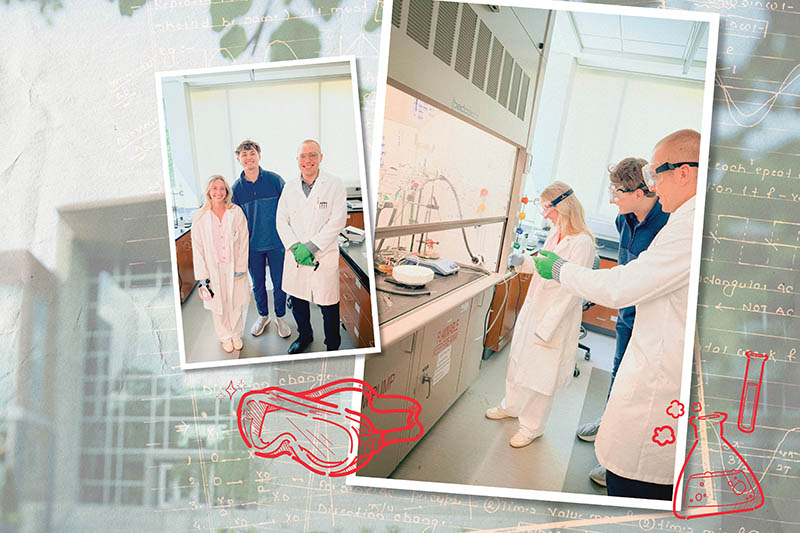
When children are asked what they want to do with their lives, so many answer, “become an astronaut, a firefighter, or a scientist who cures cancer.” One of these lofty ambitions is quickly becoming a reality for Aquinas students Alexis Lamoreaux and Connor Eilar.
Having secured funding from a Mohler-Thompson Summer Research Grant, these Saints are spending the summer working on two projects— one in leukemia chemotherapeutics and the other in developing a new chemical reaction using visible light. Dr. Anthony Allen is lending his expertise and guidance as their faculty advisor for both of these projects.
A Professor Who Knows What’s Up
After graduating with his doctorate in 2023, Dr. Allen participated in a postdoctoral
program, where he met Drew Adams at Case Western Reserve University School of Medicine. The goal of his research? To create another mechanism for leukemia treatment.
The truth about the “cure for cancer” is that many treatments already exist and have been on the market for years. For leukemia alone, there are plenty of treatments available, but many use similar cell-killing strategies known as the “mechanism of action.” The fact that so many options have the same basic functionality can leave gaps that cost people their lives. Those for whom a treatment doesn’t work generally have to move to another that would function differently on the cellular level; otherwise, the results— or lack thereof— are generally the same.
“This would be really down the line, but right now I don’t think that there is, at least for leukemia, a chemotherapeutic that kills cancer cells by inhibiting sphingolipid metabolism,” Dr. Allen shared. “Sphingolipids are important components of cell membranes, which play a pivotal role in communication between cells and in maintaining the structural integrity of the interior contents of the cell.”
To break this down simply, the human body has proteins known as enzymes that facilitate chemical reactions to keep our cells healthy. A small molecule can bind to these enzymes and inhibit their function. Various enzymes are responsible for making sphingolipids, which promote cell health. In certain leukemia cells, there is a greater sensitivity to altering the composition of sphingolipids relative to healthy cells; therefore, they are more susceptible to this kind of intervention.
This current research aims to create “a way to selectively target leukemia cells, to kill them while saving healthy cells,” explained Dr. Allen.
While he had to pause work on this research in the transition from his postdoctoral position into his role as a chemistry professor at Aquinas, he still maintained that connection to his former advisor.
He reached out and proposed that he could have a few of his students synthesize small molecules designed by him and Dr. Adams that could inhibit a leukemia cell’s ability to make sphingolipids. Much like a musical “variation on a theme,” the designed molecules introduce small changes to those previously studied by Dr. Adams and Dr. Allen, known to kill leukemia cells by interrupting sphingolipid metabolism, in order to test how those variations affect their ability to kill leukemia cells. This process is called a ”structure-activity relationship” study.
The answer he received from Drew was a resounding yes!
Reading Literature, Performing Tests, Saving Lives
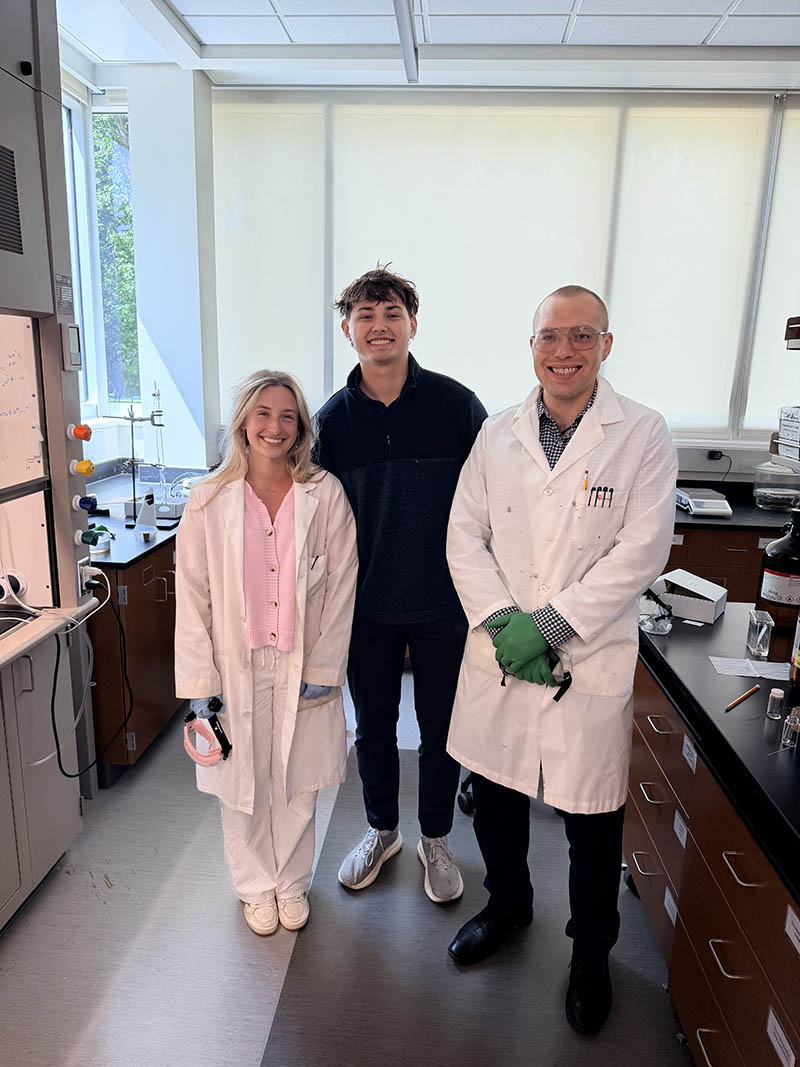
When asked what their roles look like on a daily basis, both Alexis and Connor noted
that it really depends on which stage the research is in.
“For our first few weeks, we would come into the lab and generally start a reaction. Then, the reaction would run until after our lunch. And then we would come back and purify it. The next day, we could test it,” Alexis explained.
Overall, both have been amazed by how many opportunities they’ve had to learn beyond the actual testing. They’ve spent a significant amount of time reviewing the current literature related to their research, especially when trying to understand why certain tests didn’t produce the results they expected. Additionally, Dr. Allen has invited them to attend his meetings, not only for the chemotherapeutics research project but also for the new chemical reaction project, which has given them even more opportunities to learn and contribute.
“It’s definitely a look into how labs actually work,” shared Alexis. “You feel like you’re actually doing things. You feel like you’re an associate more than a student.”
Most of their days are spent right at Aquinas in the organic chemistry teaching lab, located in the Albertus Magnus Hall of Science. Those classrooms are largely free during the summer, so they have had full access to set up their equipment and fully utilize that space.
They have also visited GVSU a few times to use their NMR (Nuclear Magnetic Resonance) Spectrometer, which allows chemical researchers to analyze compounds that are far too small to be seen with a traditional light microscope. Although Aquinas has a similar machine, Alexis and Connor hope to publish their research, so they need the higher-quality data provided by a newer model. These visits are simply to confirm their findings with greater precision and to collect publication-quality data.
Fun fact: According to Dr. Allen, Aquinas even helped co-write the grant that got Grand Valley that instrument in 2018.
Even though much research still lies ahead, both Alexis and Connor expressed feeling a sense of accomplishment in the work they’ve already completed.
Connor shared that he created an analog that didn’t have any prior literature on it—meaning that it had never been made before. “It was the first time this chemical had existed. So after we confirmed that that’s what it was, it felt really good. Like, wow, I did something,” said Connor.
And while the two are not yet certain whether or not the exact molecules they’re making will turn out to be cytotoxic, their findings this summer will still help to further leukemia research.
“We really are helping people, and that’s really remarkable,” shared Alexis. “Helping people has always been something that I’ve been passionate about. It’s really satisfying to be able to say that you’re trying your best to help people. Sometimes you’ll lose sight of that when you’re in the lab, and you’re just on autopilot making stuff. But it’s so fun to talk about because this could really change someone’s life.”
A Second Research Project and a New Challenge
In addition to their cancer research, the team has also been working on a second project
this summer, allowing the students to explore another area of chemistry. Their objective:
Develop a new chemical reaction using visible light.
Dr. Allen’s PhD focused on visible light photoredox catalysis, a scientific term for using ordinary visible light (the same kind of light we see every day) to produce chemical reactions.
In the past, chemists often relied on ultraviolet (UV) light, which is much more powerful but can also trigger unwanted reactions. This makes it harder to control the outcome. By using visible light together with a special catalyst that helps move electrons between molecules, chemists can guide reactions more precisely, making the process gentler, more efficient, and better at producing the desired results.
“So I learned a lot of different ways that light can be used, and I thought that maybe we can have two molecules that, using visible light, we can do what’s called a coupling, where you bring two different molecules into one bigger one,” Dr. Allen explained.
“The most important bond is the carbon-carbon bond. All of our little organic molecules are chains or rings of carbon. So the most general and useful bond for a reaction to make is the carbon-carbon bond. I think that with my doctoral knowledge, we should be able to design a new C-C, carbon-carbon, coupling reaction using a cheap precursor like thiourea.”
 Lights, Protective Goggles, Action!
The “stars of the show” were the four lights they were able to procure from a college
grant that Dr. Allen pursued through Aquinas’ Faculty Development Committee.
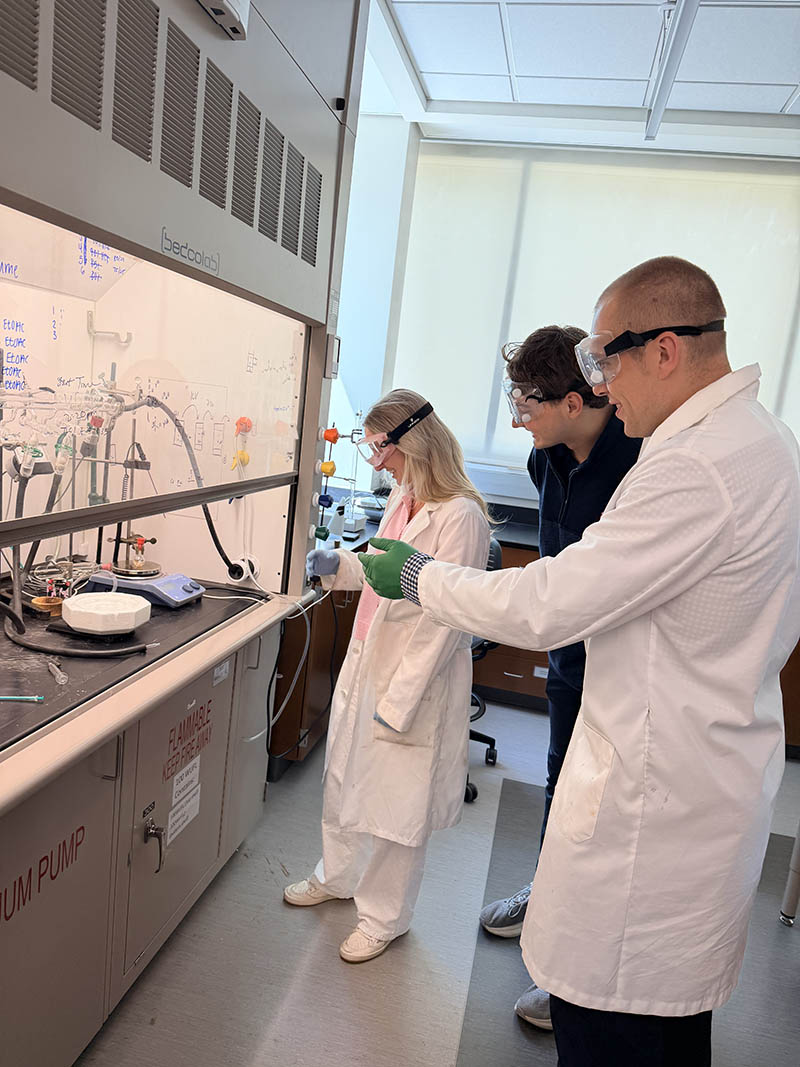
Each light produces a different wavelength, ranging from the highest energy light (purple) down to the lowest energy (red). The violet/purple light shines at 390 nanometers, the two shades of blue at 425 and 456, and the “most interesting” red light at 660.
“They’re super bright, though. Like, don’t look at it,” Alexis laughed. “…We looked at it.”
They explained that they wear different goggles with a colored lens complementary to each color light. As an example, for the blue light, orange is required.
“I’d say the coolest part about this project is that the first time I learned about photocatalysis or photoredox or anything like that was in the second semester of Organic Chemistry. I asked Dr. Allen about it, and he was like, ‘Oh, that’s actually what I did my doctorate in.’ And he sent me his papers, and I read them,” Connor recollected. “It’s super cool seeing it in action and learning different topics that we didn’t cover in class.”
Photochemistry isn’t covered as much in a typical undergraduate chemistry curriculum. This project instead acts as an extension to the material a student might learn in an upper-level elective organic chemistry course in undergrad or even an entry-level graduate course.
“I was super excited when he told us what we’d be working on because it’s exactly what I’m interested in,” Connor shared.
While Connor and Alexis have spent most of their summer so far on the leukemia research, they’re looking forward to more experimentation before fall classes are back in session.
The Value of Faculty Mentorship and a Solid Learning Foundation
Student research under a dedicated faculty member is one of the most beneficial experiences
a student can have in college, right up there with a fancy internship or study abroad
opportunity. Not only can it help boost your resume and help you get into grad programs,
but you also learn a lot about yourself— and you form deep relationships in the process.
Alexis is a biochemistry major and has always been interested in conducting research in college. Her dream is to go to dental school after she graduates; however, now that she has had this experience, she intends to spend a few gap years doing more research beforehand.
“Now I feel very much like a scientist instead of a student. It’s crazy how you feel different,” Alexis shared, expressing just how much more confident she feels now, having hands-on experience. “In a classroom lab, you feel almost uneasy because everything is new. And everything is new here, too, but you feel more confident because you have such a base of learning, and you have all the tools. Having a good advisor, I have learned so much, even about myself and how I deal with challenges.”
Similarly, Connor is a health science major and has been looking deeper into Ph.D programs now that he has had this experience. He shared Alexis’ sentiment, especially about being able to handle research methods on his own for the first time.
When first performing an esterification, Connor explained how difficult it was for him to make it work correctly. This summer has given him the space to practice that skill and perfect it. Now, he has more faith in his abilities.
“It felt good. I felt like a chemist,” he reflected.
“You really have to trust yourself,” added Alexis. Dr. Allen “tells us all the time that we know more than we think we do, and it’s so true. So just keep going. We really are blessed to have him. He is exactly what I hoped my research advisor would be like.”
In response, Dr. Allen offered, “I mean, part of the responsibility of a professor, especially at a place like Aquinas, is not just to form people into research robots that can churn out new molecules. It really is to form them into better students and better people. Even if they don’t become chemists, the perseverance, the fortitude, and the study habits that they gain in this research project will serve them— not only in their work but in their relationships. It’s a great privilege as a professor to be able to do that.”