Three Pillars of Computer Information Systems
Three Pillars of CIS
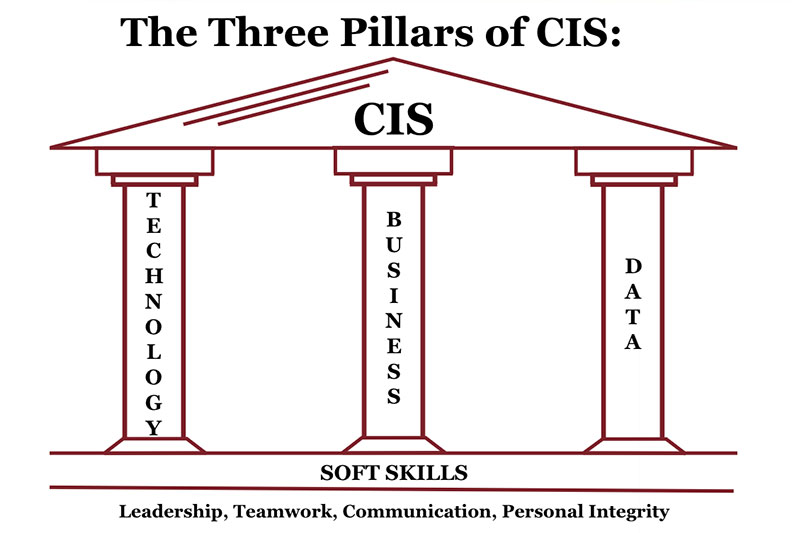
Computer Information Systems (CIS) is built on the three pillars of technology, business, and data, with a solid foundation in soft skills such as leadership, teamwork, communication, and personal integrity.
Technology
A CIS degree provides a comprehensive foundation in key areas of technology, equipping students with the skills needed to excel in the rapidly evolving tech landscape.
- Programming – Creating applications to solve user needs.
- Web Technologies – Creating websites that can connect to the world.
- Networking – Connecting computers to other computers and the Internet.
- Security – Keeping everything safe.
Business
A CIS degree provides a comprehensive foundation in key areas of business, equipping students with the skills needed to thrive in the modern business and technology landscape.
- Project Management – Explores how to create, document, and implement a project, whether it be for business or personal.
- Economics – Emphasis on the production, distribution, and consumption of goods and services.
- Finance – Addresses matters regarding the management, creation, and study of money and investments.
- Accounting – System of recording and summarizing business and financial transactions and analyzing, verifying, and reporting the results.
- Systems Analysis – This involves the investigation of what makes business and IT procedures work and seeks ways to improve them.
- Leadership – Learning what it takes to lead people and organizations to success.
- Marketing – Teaching how to promote and sell products or services, including marketing yourself to be more valuable to employers.
- Management – Administering and coordinating resources to accomplish organizational goals effectively.
Data
A CIS degree provides a solid foundation in data analytics and big data transformation. Students gain knowledge in database management and data analysis tools through hands-on experience and practical applications
- Databases – Studying the ways data is stored and turned into information to make better business decisions.
- Descriptive Statistics – Learning how to summarize and describe data sets.
- Inferential Statistics – Choosing the proper samples of a population and then making predictions based on the data sample.
- Data Management – Keeping the data confidential, ensuring its integrity, and keeping it available to the authorized users
- SQL – Using structured query language to create, read, update, and delete data.
- Data Analytics – Brings all of the aforementioned items together under one umbrella.