Nursing Glossary
Nursing Glossary
No matter where you get your degree, there are terms you need to know. This glossary of terms is here to serve you in your search, and it will help you better understand how the University of Detroit Mercy nursing program at Aquinas College stands out from the rest.
- Direct Admit
- NCLEX
- NCLEX pass rate
- Mission
- Curriculum
- Cohort model
- Clinical
- Student to clinical faculty ratio/class size for clinicals
- Simulation (SIM)
- Simulation (SIM) Lab
- Anatomage Table
- Peer tutoring
- UDM’s Student Mentor Program
- Student Nurse Association (SNA)
- Self-Care
- Nursing pins
- AACN
- CCNE
1. Direct Admit
A direct admit nursing program lets you get a spot in the nursing program the moment you're accepted to the college. You don't have to apply again later or compete for a seat after your first year or two of college classes.
The UDM nursing program at Aquinas is a direct admit school with a four-year curriculum. All students who apply for the nursing program and are admitted start as nursing students. If a nursing student passes all of her classes, she will graduate in four years.
2. National Council Licensure Examination (NCLEX)
The NCLEX is the nursing licensing exam that students take after earning their Bachelor of Science in Nursing (BSN). All nursing students are required to pass the NCLEX before they can work as a licensed registered nurse.
UDM nursing students at Aquinas are well prepared to take the NCLEX through the coursework, practice NCLEX tests, and clinical experiences.
3. NCLEX Pass Rate
The NCLEX pass rate is the percentage of nursing graduates who pass the NCLEX. For example, if 90 out of 100 graduates pass, the pass rate is 90 percent.
For two years in a row, UDM nursing students at Aquinas have had a 100% pass rate on the first attempt! Historically, the NCLEX pass rate for UDM nursing students at Aquinas has been above state and national averages.
4. Mission
A school or nursing program's mission explains its main purpose. It describes what the program wants to do for its students, patients and community.
UDM's McAuley School of Nursing at Aquinas prepares compassionate and competent baccalaureate and graduate-level nurses who are committed to serve, lead and provide quality culturally sensitive health care to diverse individuals, families, communities and populations.
Our mission is what makes our nursing students distinct.
5. Curriculum
The curriculum involves the classes students need to complete to graduate from a nursing program. It's like a road map for their education.
UDM nursing at Aquinas has a direct admit, four-year curriculum, clearly showing all four years of coursework as the path to graduation.
6. Cohort Model
A cohort model means a group of students starts the nursing program together and takes many of the same classes together. Students can become a team and support each other throughout the program.
The UDM nursing program at Aquinas uses the cohort model.
7. Clinical
A clinical is the part of nursing school where students apply nursing skills with patients in places such as hospitals, clinics, healthcare settings and in the community. Students learn with clinical instructors and a healthcare team, such as nurses, doctors, respiratory therapists, etc.
All of the UDM nursing at Aquinas clinicals are held in the Grand Rapids area.
8. Student-to-Clinical Faculty Ratio / Class Size for Clinicals
The student-to-clinical faculty ratio describes the number of students who learn with each clinical faculty member. A smaller group may give students more opportunities to ask questions and receive individual help.
The student-to-clinical faculty ratio for UDM nursing students is usually 6:1.
9. Simulation (SIM)
Simulation is a safe way for nursing students to practice nursing skills and make decisions without putting a real patient at risk. Students practice caring for high-fidelity, lifelike manikins that act like a patient. Simulation takes place in a SIM lab.
New for Fall 2026! UDM nursing at Aquinas has new state-of-the-art manikins: a birthing mother, an elderly male, a newborn, infant, toddler and junior.
10. Simulation (SIM) Lab
A SIM lab is designed to duplicate a hospital environment where students safely practice patient care, critical thinking, and clinical judgment before working with actual patients.
UDM nursing at Aquinas has a dedicated simulation suite within the Albertus Magnus Hall of Science.
11. Anatomage Table
The Anatomage Table is an advanced interactive touchscreen workstation where students explore 3D digital human bodies.
The Albertus Magnus Hall of Science on Aquinas' campus houses an Anatomage Table. Students access it during their science and nursing courses. It's an essential tool in anatomy and physiology coursework and complements the SIM lab learning experience.
12. Peer Tutoring
Peer tutoring involves nursing students getting help from other students who understand the material and have achieved high competency levels. A peer tutor can help review information, practice skills, ask questions, and prepare for exams.
UDM nursing students at Aquinas have access to different types of academic support, including peer tutors, study tables and a writing center.
13. UDM’s Student Mentor Program
UDM nursing at Aquinas offers a student mentor program where freshman nursing students are paired with junior nursing students who can share tips, answer questions, and help new students feel comfortable. Sophomore students are paired with senior students, so all nursing students participate.
14. Student Nurses Association (SNA)
The Student Nurses’ Association (SNA) is a nationally recognized student group for nursing students. Members can learn more about nursing, meet other students, volunteer, attend events, and develop leadership skills.
All nursing students in the UDM nursing program at Aquinas are automatically enrolled in the SNA.
15. Self-Care
Self-care means taking care of your body, mind, and spirit. For nursing students, this can include getting enough sleep, eating healthy foods, exercising, taking breaks and asking for help when needed.
UDM nursing students are taught the importance of self-care throughout their program.
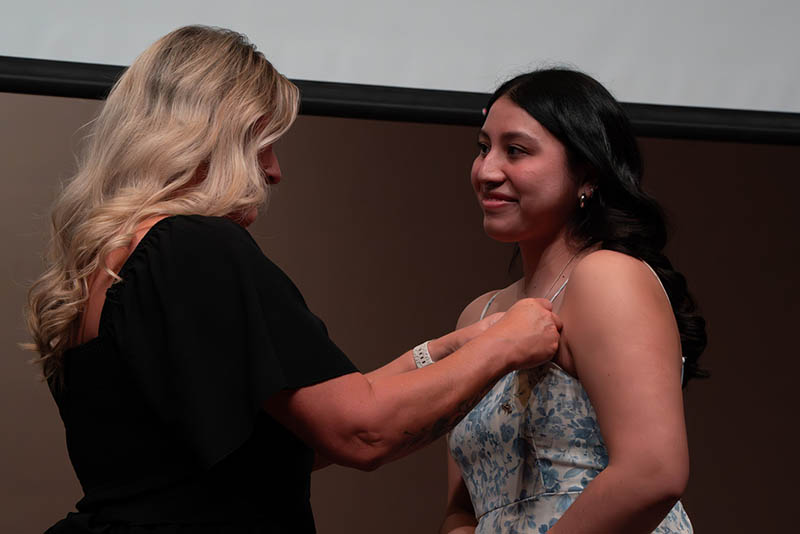
16. Nursing Pins
A nursing pin is a special pin presented to senior students at the end of their senior year, prior to graduation. It represents becoming part of the nursing profession and is given during a special pinning ceremony. Each nursing school has a one-of-a-kind pin.
17. American Association of Colleges of Nursing (AACN)
This organization helps nursing schools understand what students should learn and be able to do to become safe and prepared nurses.
UDM nursing at Aquinas adheres to the AACN guidelines.
18. Commission on Collegiate Nursing Education (CCNE)
The CCNE reviews nursing programs to make sure they meet important standards for nursing education. It is a type of accreditation that shows a nursing program has met established national quality standards.
UDM's nursing program is accredited by the CCNE and approved by the Michigan Board of Nursing.
CONTACT INFO
Nursing Admissions
(616) 632-2878
admissions@aquinas.edu